
Bosch Mini Split Error Codes: EL, EH, EC, P6 and What They Mean
🕒 Last updated:
Bosch error codes — quick lookup
The Bosch mini-split error codes homeowners hit most, across Climate 5000 generations. Codes vary by generation and by single-zone versus multi-zone — confirm yours against the Bosch service manual for your model.
| Code | What it means | What to do |
|---|---|---|
dF / CL / FP / FC / AP / CP | Normal status displays — defrost, filter reminder, low-room-temp heating, forced cooling, Wi-Fi pairing, remote off | Nothing to fix. These are not faults |
E1 (Gen 2) · EL 01 (Gen 3) · E2 (multi ODU) | Indoor and outdoor units are not communicating | One power cycle of 2–3 min. If it returns, wiring or board → technician |
E0 / F4 (Gen 2) · EH 00, EH 0A, EC 51 (Gen 3) | EEPROM parameter error on the indoor or outdoor control board | One power cycle. If it returns, board replacement → technician |
P0 (Gen 2) · PC 00 (Gen 3) · P6 (multi ODU) | Inverter module (IPM) malfunction or IGBT over-current | Stop. High-voltage inverter fault → licensed technician |
P1 (Gen 2) · PC 01 (Gen 3) · E5 (multi ODU) | Over-voltage or under-voltage protection | Check the breaker and supply; persistent → electrician or technician |
P3 (Gen 2, low-temp lockout) · PC 08 (Gen 3, current overload) | Two different faults that share a letter across generations | Read the table for your generation before acting |
EC (Gen 2) · EL 0C (Gen 3) | Low refrigerant, or refrigerant leakage detection | Refrigerant work is EPA-regulated → technician only |
E3 (Gen 2) · EH 03 (Gen 3) · E8 / F5 (multi) | Fan speed operating outside the normal range | Clear obstructions and check the filter; persistent → technician |
Bosch mini split error codes are short display messages — or, on units without a display, counted blinks of the indoor lamps — that tell you which internal self-check failed. The awkward part with Bosch specifically is that there is no single list. Three different code sets are in service in North American homes right now, and the same characters can mean different things in each one.
This page carries all three, taken from the Bosch Home Comfort service and installation manuals for the Climate 5000 range, plus the part almost nobody explains: on a multi-zone system, the outdoor board and the indoor display show different codes for the same fault.
Which Bosch system do you have?
Before reading any table, work out which of the three code sets applies. Getting this wrong is the most common reason a Bosch mini-split error code looks like it means something alarming when it does not.
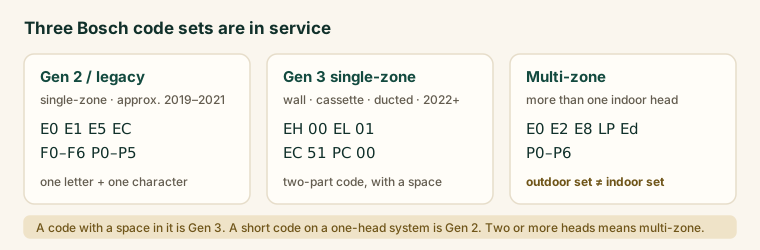
| System | Typical era | Code style | Example codes |
|---|---|---|---|
| Climate 5000 Gen 2 and legacy single-zone | roughly 2019–2021 | one letter plus one character | E0, E1, E5, EC, F0–F6, P0–P5 |
| Climate 5000 Gen 3 single-zone (wall, cassette, ducted) | 2022 onwards | two-part code | EH 00, EL 01, EC 51, PC 00 |
| Climate 5000 multi-zone (multi-split) | both generations | outdoor set, plus a different indoor set | E0, E2, E8, P0–P6, LP, Ed |
Gen 2 and legacy single-zone
One indoor head paired with one outdoor unit, installed roughly between 2019 and
2021, showing short codes such as E1, E5 or P3. The lamp patterns for this
generation put outdoor faults on a lit TIMER lamp, which no other Bosch
generation does.
Gen 3 single-zone
Wall-mounted, four-way cassette and ducted Climate 5000 systems from 2022
onwards. The giveaway is the shape of the code itself: two parts with a space,
such as EL 01 or PC 02. This is the set Bosch still publishes service manuals
for, most recently in 2025.
Multi-zone
Two or more indoor heads on a single outdoor unit. This is the awkward one,
because the outdoor board and the indoor head do not agree on what to call a
fault. Everything on this page about P6 and P0 applies to multi-zone systems
only.
Three quick ways to tell them apart:
- A code with a space in it —
EL 01,EH 60,PC 02— is a Gen 3 single-zone code. - One indoor head, one outdoor unit, and a short code like
E1orP3is Gen 2 or legacy. - More than one indoor head on a single outdoor unit is multi-zone, and the code you are looking at depends on where you read it.
If you are not sure, the model number on the outdoor unit’s data plate settles it. Bosch publishes the manual for every ductless model, and the error-code table is always in the back of the installation or service manual.
Where the code appears on a Bosch mini-split
Bosch shows fault information in up to four places, and they do not all carry the same amount of detail:
- The indoor unit’s LED display
- The RUN and TIMER indicator lamps
- The wired wall thermostat, where one is fitted
- The outdoor unit’s own control board
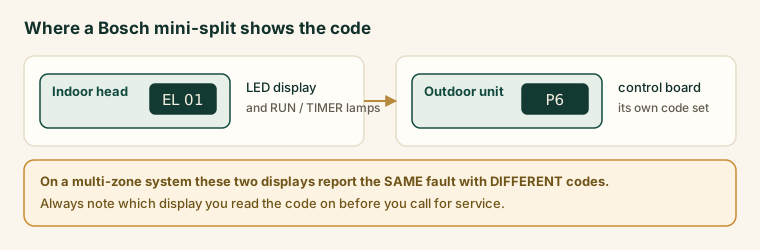
The indoor LED display
A small display behind or beside the louvre on wall-mounted heads. This is where a homeowner will normally see the code, and it is the display the FAQ answers on this page assume unless it says otherwise.
The RUN and TIMER lamps
Units without a numeric display still report the code, by flashing it. This is covered in the next section.
The wired wall thermostat
Gen 3 systems fitted with the optional wired wall thermostat mirror the code there, which is often easier to read than squinting at the head.
The outdoor control board
Multi-zone outdoor units carry their own display with their own code set. This is the one a technician reads, and it is the reason the two numbers you are given may not match.
A code seen on the outdoor board and a code seen on the indoor display are not interchangeable. Note down which one you read.
How to read the RUN and TIMER blink patterns
If your Bosch head has no numeric display, the code is still there. It is counted out on the lamps: a number of RUN flashes, combined with what the TIMER lamp is doing.
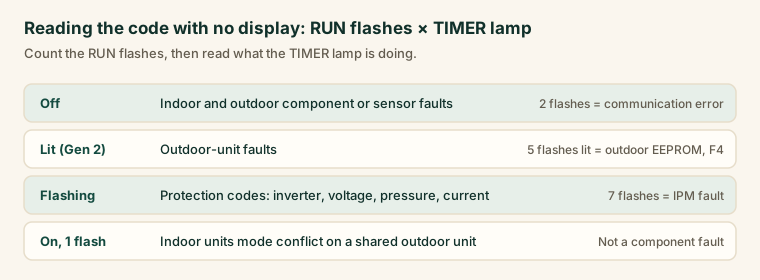
| TIMER lamp | What that group is | Example |
|---|---|---|
| Off | Indoor-side and outdoor-side component or sensor faults | 2 RUN flashes is the communication error |
| Lit (Gen 2) | Outdoor-unit faults | 5 flashes lit is the outdoor EEPROM error, F4 |
| Flashing | Protection codes: inverter, voltage, pressure, current | 7 flashes flashing is the IPM fault |
| On, with 1 flash | Indoor units mode conflict on a multi outdoor unit | Not a component fault |
Count the RUN flashes twice before you act. The gap between repeats is longer than the gap between flashes, which is how you find the start of the pattern.
Codes that are not faults at all
This is the fastest win on the page. Several Bosch displays look like error codes and are not. Bosch’s own service manual lists them under the heading “Normal Display, not error code”.
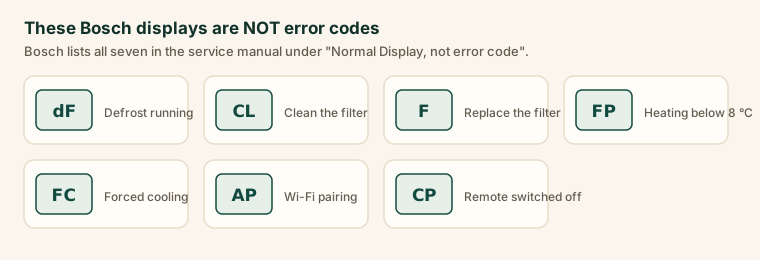
| Display | What it actually is |
|---|---|
dF | Defrost. The system is melting frost off the outdoor coil |
CL | Filter-cleaning reminder, shown for 15 seconds at power-on, or Active Clean running |
F | Filter-replacement reminder, shown for 15 seconds at power-on |
FP | Heating with room temperature under 8 °C / 46 °F |
FC | Forced cooling, a service mode |
AP | Wi-Fi access-point pairing mode |
CP | The remote control switched the unit off |
The two that generate the most unnecessary calls
dFin winter, mistaken for a breakdown because the unit stops heating and steamsCLat power-on, mistaken for a fault code because it appears in the same place a real code would
If your Bosch mini-split is showing one of these, nothing is broken. dF in
particular alarms people every winter. It is the normal defrost cycle, and the
steam coming off the outdoor unit while it runs is
normal too.
No code at all, just water?
A Bosch that is dripping or pooling water usually shows no error code, because nothing electrical has failed — the condensate simply has nowhere to go. That is a drain problem, not a fault code, and Bosch units have their own quirks there: the hose ships on the left and can be swapped to the right, the hole it came from has to be plugged, and heat pump outdoor units need a drain joint that often gets left in the box.
Those are covered step by step in cleaning the drain hose on a Bosch mini split.
Climate 5000 Gen 3 — the full error code table
These are the codes on current Bosch Climate 5000 Gen 3 single-zone systems — wall-mounted, four-way cassette and ducted — as published in the 2025 Bosch service manuals. The left column is the counted RUN-lamp pattern for units without a display.
Indoor and sensor faults (TIMER lamp off)
| RUN flashes | Code | Meaning |
|---|---|---|
| 1 | EH 00 / EH 0A | Indoor unit EEPROM parameter error |
| 2 | EL 01 | Indoor and outdoor unit communication error |
| 3 | EH 02 | Zero-crossing signal detection error |
| 4 | EH 03 | Indoor fan speed operating outside the normal range |
| 6 | EH 60 | Indoor room temperature sensor T1 open circuit or short circuit |
| 6 | EH 61 | Evaporator coil middle temperature sensor T2 open or short |
| 9 | EH b0 | Indoor PCB and display board communication error |
| 8 | EL 0C | Refrigerant leakage detection |
Of this group, two account for most calls:
EL 01, the communication error, which is the single most reported Bosch codeEH 03, the indoor fan speed error, which is very often just a blocked filter
Outdoor faults (TIMER lamp off)
| RUN flashes | Code | Meaning |
|---|---|---|
| 5 | EC 51 | Outdoor unit EEPROM parameter error |
| 5 | EC 52 | Condenser coil temperature sensor T3 open or short |
| 5 | EC 53 | Outdoor ambient temperature sensor T4 open or short |
| 5 | EC 54 | Compressor discharge temperature sensor TP open or short |
| 5 | EC 56 | Evaporator coil outlet sensor T2B open or short, on free-match indoor units |
| 12 | EC 07 | Outdoor fan speed operating outside the normal range |
Four of the six outdoor codes are sensors, and the pattern is worth noticing:
EC 52,EC 53,EC 54andEC 56all share a five-flash RUN pattern, so the flash count alone cannot separate them — you need the displayEC 51shares that same five-flash pattern too, and it is a board fault rather than a sensor
Protection codes (TIMER lamp flashing)
| RUN flashes | Code | Meaning |
|---|---|---|
| 7 | PC 00 | IPM malfunction or IGBT over-current protection |
| 2 | PC 01 | Over-voltage or under-voltage protection |
| 3 | PC 02 | Compressor top temperature, IPM high temperature, or high-pressure protection |
| 7 | PC 03 | Low-pressure protection |
| 5 | PC 04 | Inverter compressor drive error |
| 1 | PC 08 | Current overload protection |
| 6 | PC 40 | Communication error between the outdoor main chip and the compressor drive chip |
Note two collisions in this group that make the display, not the lamp, the reliable source:
PC 00andPC 03both flash seven timesPC 01andPC 02are only one flash apart, at two and three
A single RUN flash with the TIMER lamp on, not flashing, is not a component fault at all. It is an indoor-unit mode conflict on a system sharing one outdoor unit, meaning one head is asking for heating while another asks for cooling.
What the EH, EL, EC and PC prefixes mean
Gen 3 codes become readable once you know the prefix, which is worth more than memorising the table.
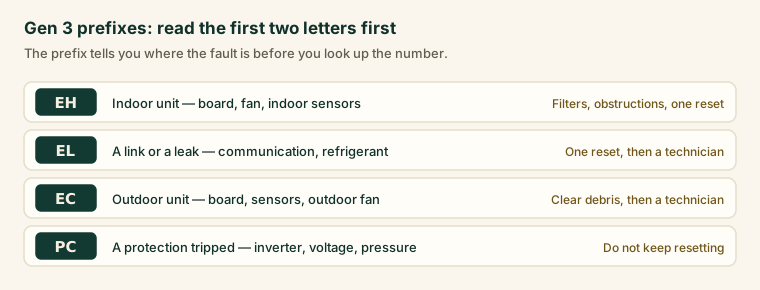
| Prefix | Where the fault is | Can a homeowner act? |
|---|---|---|
EH | Indoor unit: board, fan, indoor sensors | Sometimes: filters, obstructions, one reset |
EL | A link or a leak: communication, refrigerant detection | Rarely: one reset, then a technician |
EC | Outdoor unit: board, outdoor sensors, outdoor fan | Clear debris around the unit, then a technician |
PC | A protection has tripped: inverter, voltage, pressure, current | No. Protection codes need diagnosis |
Reading a Gen 3 code therefore goes in three steps:
- Read the prefix to place the fault indoors, outdoors, on a link, or on a protection.
- Read the number to name the exact component or limit.
- Decide from the prefix alone whether it is a homeowner check or a service call.
EH and EC faults are usually a component that has failed or a wire that has
come loose. PC codes are different in kind: nothing has necessarily broken yet,
the system has stopped itself because a measured value went out of range.
Resetting a PC code repeatedly is the one habit most likely to turn a protected
system into a damaged one.
Climate 5000 Gen 2 and legacy single-zone — the full error code table
Older Bosch Climate 5000 wall-mounted single-split systems use a shorter set. This is the table Bosch prints in the installation manual, including the lamp pattern for each code.
| Code | Meaning | RUN flashes | TIMER lamp |
|---|---|---|---|
E0 | Indoor unit EEPROM error | 1 | Off |
E1 | Communication error between indoor and outdoor units | 2 | Off |
E3 | Indoor fan speed error | 4 | Off |
E4 | Indoor return-air temperature sensor error | 5 | Off |
E5 | Indoor coil temperature sensor error | 6 | Off |
EC | Low refrigerant | 7 | Off |
F0 | Outdoor current overload sensed | 1 | Lit |
F1 | Outdoor ambient temperature sensor error | 2 | Lit |
F2 | Outdoor coil temperature sensor error | 3 | Lit |
F3 | Compressor discharge temperature sensor error | 4 | Lit |
F4 | Outdoor unit EEPROM error | 5 | Lit |
F5 | Outdoor unit fan speed error | 6 | Lit |
F6 | Indoor coil outlet temperature sensor error | 7 | Lit |
P0 | Inverter module (IPM) error | 1 | Flashing |
P1 | High or low voltage protection | 2 | Flashing |
P3 | Outdoor unit low-temperature lockout | 4 | Flashing |
P4 | Compressor drive error | 5 | Flashing |
P5 | Mode conflict | 6 | Flashing |
Two of these trip people up regularly:
ECon Gen 2 means low refrigerant. On Gen 3,ECis a prefix for outdoor-unit faults and means nothing on its own. Same two letters, completely different job.P3on Gen 2 is a low-ambient-temperature lockout — the outdoor unit declining to run because it is too cold outside, which is protective rather than broken.
Multi-zone Bosch systems — outdoor codes and indoor codes differ
This is the section that is missing from most Bosch code pages, and it is the reason multi-zone diagnostics go wrong.
On a Bosch multi-zone Climate 5000, the outdoor unit’s display and the indoor head’s display report the same fault with different codes. Bosch prints both columns in the multi-split installation manual.
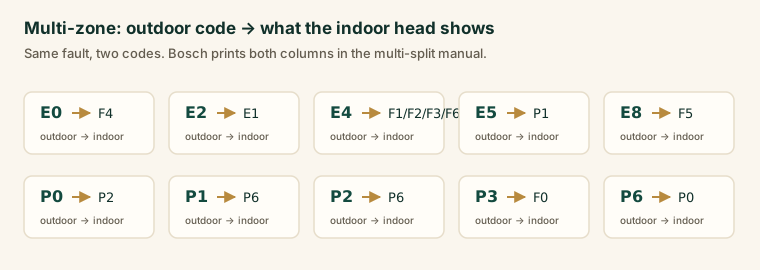
| Outdoor display | Fault | Indoor display shows |
|---|---|---|
E0 | Outdoor unit EEPROM parameter error | F4 |
E2 | Communication failure between indoor and outdoor units | E1 |
E3 | Communication failure between the IPM board and the outdoor main control board | Not shown |
E4 | Outdoor temperature sensor fault: T3 coil, T4 ambient, T5 discharge, T2B indoor coil outlet | F2 / F1 / F3 / F6 |
E5 | Over-voltage or under-voltage protection | P1 |
E6 | PFC module protection | Not shown |
E8 | Outdoor fan speed malfunction | F5 |
P0 | High-temperature protection of the compressor top | P2 |
P1 | High-pressure protection | P6 |
P2 | Low-pressure protection | P6 |
P3 | Current overload protection | F0 |
P4 | Compressor discharge temperature protection | Not shown |
P5 | Condenser high-temperature protection | Not shown |
P6 | Inverter module (IPM) malfunction | P0 |
LP | Low ambient temperature protection | Not shown |
Ed | Adapter board to outdoor main control board communication failure, on specific Gen 3 models | Not shown |
Indoor coil-outlet sensor faults are reported per head: F1 through F6
correspond to indoor units A through F, which is how a technician finds out which
room’s head has the failed sensor without opening all of them.
Two consequences worth knowing before a service visit:
- A code in the
F1–F6range on a multi-zone outdoor board is naming a room, not a fault type - The same letters on a Gen 2 single-zone system mean something completely different, because there is only one head to name
Two consequences worth knowing before a service visit:
- A code in the
F1–F6range on a multi-zone outdoor board is naming a room, not a fault type - The same letters on a Gen 2 single-zone system mean something completely different, because there is only one head to name
The P6 problem — why P6 means two different things
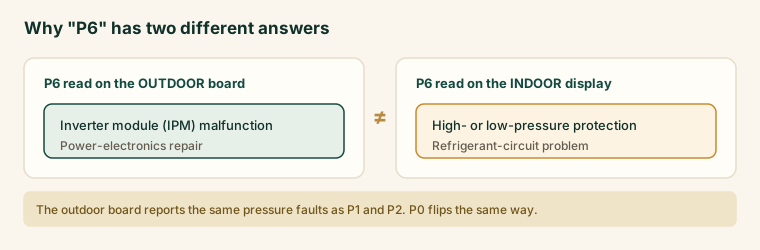
Take the two rows for P6 above and read them together:
- On the outdoor board,
P6is an inverter module (IPM) malfunction. - On the indoor display,
P6is what high-pressure (P1) and low-pressure (P2) protection look like.
So “my Bosch mini split shows P6” has two possible answers, and they lead to
different repairs: a power-electronics fault, or a refrigerant-circuit pressure
problem. P0 flips the same way — outdoor P0 is compressor top temperature,
indoor P0 is the IPM fault.
When you call for service, say where you read the code. “P6 on the indoor head” and “P6 on the outdoor unit” are different jobs, and the difference decides what the technician brings.
EL 01, E1 and E2 — the communication error
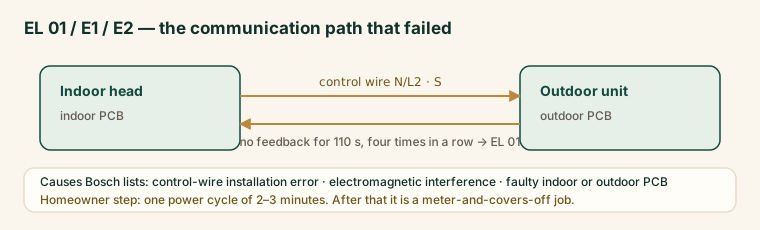
The most common Bosch mini split fault across every generation is the
indoor-to-outdoor communication error: E1 on Gen 2, EL 01 on Gen 3, E2 on a
multi-zone outdoor board.
What triggers it
Bosch defines the Gen 3 trigger precisely: the indoor unit receives no feedback from the outdoor unit for 110 seconds, four times in a row. The listed causes are:
- Incorrect installation of the indoor-to-outdoor control wire
- Electromagnetic interference
- A faulty indoor or outdoor control board
What you can safely do
Power the system off at the breaker, wait two to three minutes, restore it, and see whether the code clears. That single reset is also the first step of Bosch’s own service procedure. Beyond that, the only homeowner-safe check is visual:
- Confirm the outdoor disconnect is closed and the breaker has not tripped
- Look for obvious damage to the conduit or cable run between the two units
- Note whether the code appeared after a storm or a power cut, which points at a latched fault rather than a failed part
What a technician does next
The published diagnostic measures DC voltage between terminals N/L2 and S at the outdoor unit, then traces the wiring between the terminal blocks and the boards. The reading itself is the diagnosis: a value fixed near zero, a value swinging between negative and positive, and a value stuck positive each send the technician down a different branch. That is a job with a meter and the covers off.
EEPROM parameter errors — EH 00, EH 0A, EC 51, E0 and F4
What the fault actually is
An EEPROM parameter error means the main chip on a control board is not getting a valid response from the memory chip that stores the unit’s settings. Bosch gives two causes: incorrect installation of the indoor-to-outdoor control wire or the line-voltage wiring, and a faulty PCB.
The same fault has a different name in each set:
EH 00orEH 0A— Gen 3, indoor boardEC 51— Gen 3, outdoor boardE0— Gen 2, indoor boardF4— Gen 2 indoor display, and what a multi-zone head shows when the outdoor board reportsE0
The published procedure
- Power off, wait two minutes, restart the unit.
- If the error continues, replace the indoor main PCB.
- If it still continues, replace the outdoor main PCB.
Only step 1 is a homeowner step. Steps 2 and 3 are board replacements. It is worth knowing that this fault frequently traces back to wiring rather than the board, which is why a technician should verify the control wiring before quoting you for two boards.
EL 0C and EC — refrigerant faults
EL 0C on Gen 3 is Bosch’s refrigerant-leak detection, and EC on Gen 2 is a
low-refrigerant indication. Neither is a DIY repair. A mini-split does not consume
refrigerant: if the charge is low, it has leaked, and topping it up without
finding the leak means paying for the same repair again.
The symptoms that usually arrive with these codes are covered in more detail in our guides to a mini split not cooling, a mini split not heating and a mini split freezing up — ice on the line set is a classic low-charge signature.
Refrigerant handling is regulated. Recovering, charging and leak-testing a sealed system requires EPA Section 608 certification.
Inverter and IPM faults — PC 00, P0 and multi-zone P6
The IPM, or intelligent power module, is the block of power electronics that drives the compressor at variable speed. When it reports a fault, the system stops on purpose.
| Generation | Code | Reported as |
|---|---|---|
| Gen 3 single-zone | PC 00 | IPM malfunction or IGBT over-current protection |
| Gen 2 single-zone | P0 | Inverter module (IPM) error |
| Multi-zone, outdoor board | P6 | Inverter module (IPM) malfunction |
| Multi-zone, indoor display | P0 | The same IPM fault, seen from the indoor side |
| Gen 3, drive communication | PC 40 | Outdoor main chip cannot talk to the compressor drive chip |
| Gen 3, drive fault | PC 04 | Inverter compressor drive error |
There is nothing safe to try here beyond one power cycle. These faults live on the high-voltage side, often on capacitors that hold charge after the power is off.
What not to do with an IPM code:
- Do not reset it repeatedly to get one more cooling cycle out of the system
- Do not open the outdoor electrical box to look, even with the disconnect pulled
- Do not accept a compressor quote before the drive board has been ruled out —
PC 04andPC 40are drive faults, not compressor faults
Voltage, current and pressure protections
These codes mean a measured value left its allowed window. The system did the right thing by stopping.
| What tripped | Gen 3 | Gen 2 | Multi-zone outdoor |
|---|---|---|---|
| Voltage out of range | PC 01 | P1 | E5 |
| Current overload | PC 08 | F0 | P3 |
| High pressure or top temperature | PC 02 | Not listed | P0 / P1 |
| Low pressure | PC 03 | Not listed | P2 |
| Low ambient lockout | Not listed | P3 | LP |
Voltage codes
Confirm the breaker is the right size and fully on, and that nothing else large is sharing the circuit. A brown-out during a heatwave produces genuine under-voltage trips, and so does an undersized or shared circuit that was never right from the day it was installed.
Current and pressure codes
Make sure the outdoor unit can breathe. The usual causes are physical:
- Leaves, cottonwood or grass clippings packed into the coil
- A fence, deck or storage box built too close to the unit
- A snow drift or ice build-up in winter
- A dirty indoor coil starving the system of airflow on the other side
Our guide to an outdoor unit not running covers what to clear and how much space to leave.
Low ambient lockout
P3 on Gen 2 and LP on multi-zone are not failures. The outdoor unit is
declining to run because it is too cold outside. If it appears in mild weather,
that is worth a service call; in a cold snap it is the system behaving as
designed.
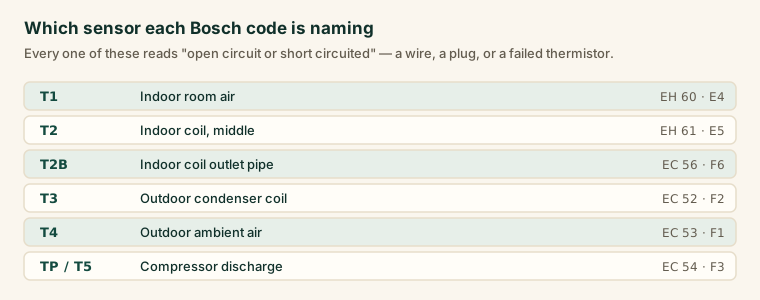
Sensor codes — what T1, T2, T2B, T3, T4 and TP are
Half the Bosch code table is sensors, and the letter tells you which one.
| Sensor | Where it is | Codes that name it |
|---|---|---|
T1 | Indoor room air temperature | EH 60, E4 |
T2 | Indoor evaporator coil, middle | EH 61, E5 |
T2B | Indoor coil outlet pipe | EC 56, F6 |
T3 | Outdoor condenser coil | EC 52, F2 |
T4 | Outdoor ambient air | EC 53, F1 |
TP / T5 | Compressor discharge | EC 54, F3 |
The code wording is always “open circuit or short circuited”, which is the signature of a broken wire, a disconnected plug, or a thermistor that has failed. These are inexpensive parts, and it is worth asking whether the sensor was actually measured before a board is quoted.
Two things this table makes easy:
- Translating a Gen 2 code into its Gen 3 equivalent, and back, when a household has both generations
- Telling an indoor-side sensor fault from an outdoor-side one before anyone opens anything
Fan speed codes — EH 03, EC 07, E3, F5 and E8
A fan-speed fault means the board asked for a speed and the feedback did not match.
Indoor fan codes — EH 03 and E3
These have homeowner causes worth ruling out first:
- A filter so loaded that airflow has collapsed. See mini split filter cleaning
- A blocked or dirty blower wheel. See DIY coil cleaning
- Something physically fouling the louvre or the wheel
- Furniture or a curtain pushed against the head, throttling the return air
Outdoor fan codes — EC 07, F5 and E8
Check for debris, then stop. Outdoor fan motors and their capacitors are line-voltage components, and a capacitor holds charge after the disconnect is pulled.
The safe reset — what a power cycle can and cannot fix
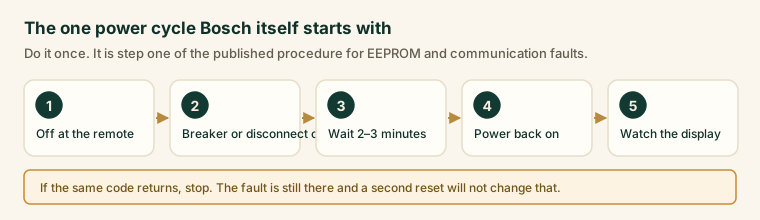
One power cycle is a legitimate diagnostic step, and Bosch uses it as step one in its own published procedures.
How to do it properly
- Turn the system off with the remote first.
- Switch off the breaker or the outdoor disconnect.
- Wait two to three minutes. The boards need time to discharge and clear state.
- Restore power and let the unit start on its own.
- Watch what the display does for the first few minutes.
What it can and cannot fix
A power cycle can clear a one-off glitch, a transient communication dropout, or a code that latched after a power outage. It cannot fix a failed sensor, a leak, a seized fan, or a board, and on protection codes it simply lets the system run back into the same limit.
If the code returns, that is your answer, and the next call is to a technician.
When to stop and call a licensed technician
Codes that go straight to a professional
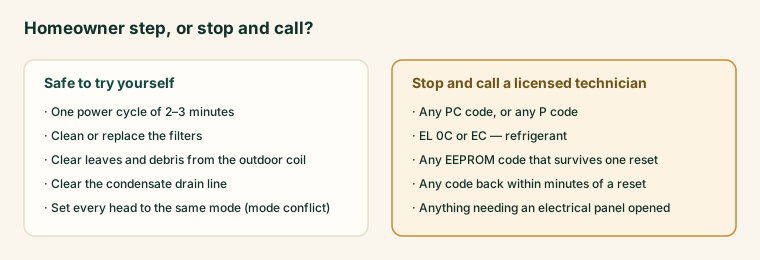
Call for any of these, without a second reset:
- Any
PCcode on Gen 3, or anyPcode on Gen 2 and multi-zone EL 0CorEC, which are refrigerant codes- Any EEPROM code that survives one power cycle
- Any code that returns within minutes of a reset
- Anything at all if you would have to open an electrical panel to go further
What to have ready when you call
- The exact code, written down as displayed
- Whether you read it on the indoor display or the outdoor board
- The outdoor unit’s model number from the data plate
- How many indoor heads are on the system
- Roughly when the fault started, and what the weather was doing
Our heat pump repair cost guide sets expectations on what the common repairs behind these codes tend to run.
Maintenance that prevents most Bosch codes
A significant share of the codes on this page — fan speed, coil sensors, high pressure, low airflow — start as maintenance that did not happen.
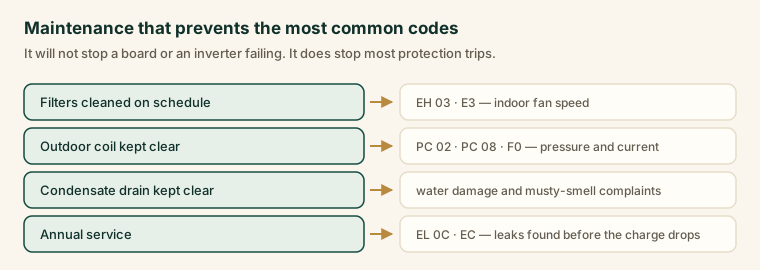
- Clean or replace the filters on the schedule the
CLandFreminders are telling you about - Keep the outdoor coil clear of leaves, cottonwood and grass clippings
- Keep the condensate drain line clear, especially in humid months
- Have the system serviced rather than waiting for a code
- Watch for the musty smell that signals a wet, dirty evaporator, which also affects indoor air quality
None of this prevents a board or an inverter failing. It does prevent the most common protection trips.
Bosch codes compared with other brands
If you are diagnosing a mixed system, or you replaced one brand with another, the letter grouping is similar across several inverter platforms but the meanings are not. Our brand hubs carry each manufacturer’s own published table:
- Gree error codes, the closest structural relative to the Bosch set
- Senville error codes
- Pioneer error codes
- MRCOOL error codes
- LG mini split error codes
- Daikin mini split error codes
- Mitsubishi mini split error codes
- Fujitsu mini split error codes
Or search every brand at once in the all-brand error code lookup, which now includes the Bosch mini-split error codes from this page.
Frequently asked questions
What do Bosch mini split error codes mean?
A Bosch mini split error code is a short display message or blink pattern that names which self-check failed, such as a sensor, a communication link, the inverter module, or a pressure or current protection. Which code set you are reading depends on the generation: Climate 5000 Gen 2 and legacy single-zone systems use single letters and digits (E0, E1, P3, F4), current Gen 3 systems use two-part codes (EL 01, EH 60, PC 00), and multi-zone systems use their own outdoor-board set.
What does P6 mean on a Bosch mini split?
It depends on which display you are reading. On a multi-zone Bosch outdoor unit, P6 is an inverter module (IPM) malfunction. On the indoor unit of the same multi-zone system, P6 is what high-pressure or low-pressure protection looks like, which the outdoor board reports as P1 or P2. Both need a technician, but they are different faults, so always say which display you read the code on.
What does E1 mean on a Bosch mini split?
On a Climate 5000 Gen 2 single-zone system, E1 means the indoor unit is not receiving feedback from the outdoor unit, which is a communication error. The same fault appears as EL 01 on Gen 3 systems and as E2 on a multi-zone outdoor board. Bosch's service procedure starts with a single power cycle of two to three minutes. If E1 returns, it is normally the indoor-to-outdoor control wiring or a control board, both of which need a technician.
Is dF an error code on a Bosch mini split?
No. dF is the defrost display. In heating, the outdoor coil collects frost and the system periodically reverses to melt it, and Bosch shows dF while that is happening. CL, F, FP, FC, AP and CP are also normal status displays, not faults. Nothing needs fixing when one of these is on screen.
Can I reset a Bosch mini split error code myself?
You can safely power the system down at the breaker for two to three minutes and restore it, which is the first step in Bosch's own troubleshooting flow and clears codes caused by a one-off glitch. Do it once. If the code returns, stop, because the fault is still there, and repeated resets on a protection code such as PC 02 or P0 let a real problem keep running.
How do I read a Bosch error code if my unit has no display?
Count the flashes. On Climate 5000 systems the RUN indicator lamp flashes a number of times while the TIMER lamp is off, lit, or flashing, and the combination identifies the code. Two RUN flashes with the TIMER lamp off is the indoor-to-outdoor communication error, for example, and seven RUN flashes with the TIMER lamp flashing is the IPM fault.
Are Bosch and Gree mini split error codes the same?
They are not the same code set, but they share a family resemblance, because several inverter platforms use the same E, F and P letter grouping for indoor faults, outdoor sensor faults and protections. Do not read a Bosch code off another brand's chart. Use the table that matches your generation, and confirm it against the Bosch manual for your model.
Sources
Every link below was checked by hand. Manufacturer documentation is the authority for your exact model — always confirm against the manual that came with your unit.
- Ductless Mini Split Heat Pumps Manuals — Bosch Home Comfort
- Climate 5000 Gen 3 Wall Mounted Ductless Single Zone — Service Manual (05.2025) — Bosch Home Comfort
- Climate 5000 Gen 3 Cassette Ductless Single Zone — Service Manual (05.2025) — Bosch Home Comfort
- Climate 5000 Gen 3 Ducted Single Zone — Service Manual (05.2025) — Bosch Home Comfort
- Climate 5000 Wall Mounted Ductless Single Split — Installation Manual (12.2020) — Bosch Home Comfort
- Climate 5000 Multi Zone Ductless — Installation Manual (12.2020) — Bosch Home Comfort
- Climate 5000 Gen 3 Multi Zone Ductless — Installation Instructions (06.2022) — Bosch Home Comfort
- Troubleshooting — Technical Support — Bosch Home Comfort
- Heat Pumps — U.S. Department of Energy
- Section 608 Technician Certification — U.S. Environmental Protection Agency
- Indoor Air Quality — U.S. Environmental Protection Agency
- ENERGY STAR — U.S. EPA / U.S. Department of Energy